Thursday, July 29, 2010
Bluebird Bitter!
Amazing! I was extremely surprised to find a bottle of Bluebird Bitter in the case of my newly discovered local liquor store. The fact that I can get a six pack and a sandwich at the same time is a winner in my book. Bluebird Bitter is a well known English bitter, and something I was very eager to try. Most English bitters and similar beers are not transported to the US at all because of their relatively low alcohol content. Low alcohol beers do not store well for long periods of time, and obviously low alcohol beers which sell for less money tend to be less worthwhile for shippers and distributors. Combine this with the relative obscurity of the style, and a very misleading name which is unappealing to many American beer drinkers, and you've got the perfect storm for a beer style you will almost never see reach American soil. Naming a beer style "bitter" is truly something that would never happen today. Bitter is, in fact, not very bitter at all (especially compared to the super bitter IPAs or the mouth-puckering swill you can buy in cans). Bitter as a name originated at a time when comparable beer would have had very little bittering at all. So bitter was probably called such not just because it was primarily a bitter beer, but because it was bittered with hops to a noticeable degree at all. The designation "bitter" seems to have started in the pubs as a nickname more than an official designation. At the time, most pubs had two offerings: bitter and mild, so the names were more relative than quantitative. In the words of beer writer Michael Jackson: "How bitter? More bitter than the mild." Of course, the history of beer name origins are all murky and people are apt to believe what the want. All this led up to me squealing* with glee at the sight of a bottle at the store. Sadly, though, the aforementioned short shelf life, and poor handling of the bottle led to a mediocre drinking experience. I was not very surprised, and beer is beer, so I enjoyed it nonetheless.
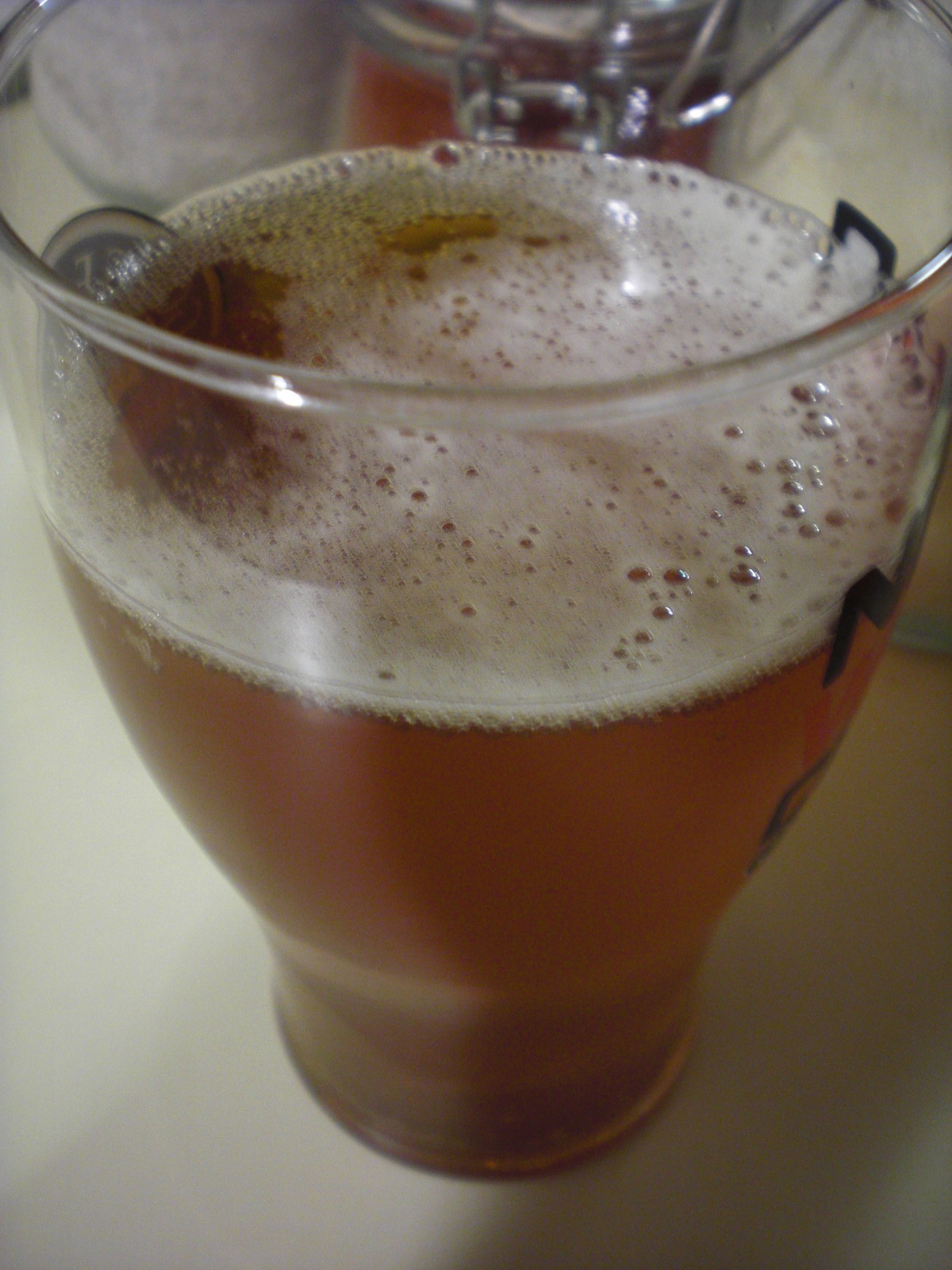
It was sadly, a bit skunky. It had a very mild flavor and aroma which led me to wonder how long it had been on the shelf. It was still very drinkable and seemed to have a minerally, British sort of finish. There was some body, though not much, and almost no sweetness. This is in contrast to most American versions of this style, which are almost like dessert beers in their sweetness and fullness. Overall, this was very nicely balanced, despite the effects of age. I could certainly see drinking several, if the fresh version is even better than this was.
*metaphorically, of course
Thursday, July 1, 2010
Drink American Beer Day
This 4th of July weekend, if you're drinking beer, I would encourage you to Drink American. On a holiday where most people will be drinking and celebrating American independence, it only seems logical that we should put our money where our mouths are and only buy real American beer. Stuff that is made here, and owned here. Budweiser, Miller, and Coors, are all owned by foreign companies. Bud is owned by Belgian InBev, Miller and Coors (which are now one company) are owned by SABMiller, a South African company. Obviously all the various fronts and sub-brands of the two big beer-marketing companies are also not American owned. Pabst, Blue Moon, Shiner, Leinenkugel's, Red Hook, and almost any other beer that sort of seems like a regional beer that you can [mysteriously] buy in every gas station and grocery store in the country would all fall into this category. Sierra Nevada, Summit, Yuengling, Sam Adams, Rogue, and literally hundreds of real, local, independant breweries are all American owned, and truly in the spirit of the holiday. In fact, I would prefer you drink beer that is made locally and regionally in a different country before you drink beer from companies who attempt to appear American owned through deception. At least you'd be drinking something honest.
So grab a bottle or a pint (or 6) of American beer and if you see someone drinking crappy beer, execute a precision throat-chop to the face, and let them know that's it's official* Drink American Beer Day.
*designation is not official in any way
So grab a bottle or a pint (or 6) of American beer and if you see someone drinking crappy beer, execute a precision throat-chop to the face, and let them know that's it's official* Drink American Beer Day.
*designation is not official in any way
Thursday, June 17, 2010
Beer Review: Great Lakes Commodore Perry
I will openly admit that I am partial to Great Lakes Brewing. This, for example, is named after Commodore Oliver Hazard Perry. Growing up near Lake Erie, the stories of Commodore Perry and his cry of "Don't give up the ship!"* were mandatory at school. He's given credit for 'saving' Lake Erie from the British and apparently a number of towns and places are named after him. When you're forced to learn about it, of course, anything that you're supposed to have respect for seems like a joke. I recall a number of lessons about Commodore Perry taught by our [fittingly] dear, drunken, social studies teacher. I wonder if the repetitive lessons were a result of heavy drinking, or if the drinking was a result of the repetitive lessons... Either way, I know the story, and it fills my heart with pride to know that Commodore Perry and the act of getting shitfaced (preferably in a public school) are linked in the mind of beer drinkers everywhere. So I may not be the world's most objective reviewer/drinker of Great Lakes' beers, but I do make an effort to be so. Because as much as I appreciate any nostalgia or loyalty to a local brewery, I don't think those warm, fuzzy feelings should be confused with what is and isn't Good Beer. That being said, every time I have pint of Great Lakes' beer, my expectations are exceeded. Their IPA, Commodore Perry, is no exception.
Stats:
abv: 7.5%
IBUs: 80
OG: 1.072
Color: golden
Ingredients: 2-row, caramel 30. Simcoe, fuggle, and cascade.
Initial impression: One of my favorite IPA's. A great example of balance despite the respectable gravity.
What I really like about this beer is that it's drinkable for being 7.5% alcohol. This is higher than many IPA's, but it's not obnoxious in this case. Commodore Perry doesn't get cloying and sweet, but you do know it's there. Hops are obviously very present without a lingering bitterness which some people find unappealing in an IPA (you can count me in that crowd). There is a very nice, soft, maltiness initially, though the palate is mostly and quickly filled with varying degrees of hopiness: fruity, bright, bitter, and then citrusy. I was surprised to see they use fuggle hops, which is unexpected in an American IPA, but it does make sense in retrospect. The earthy-bitter balance of fuggle hops is subtle but I think it really adds something to this beer.
In my opinion, 1.070 is just about the right original gravity range for an IPA. I don't know if theirs has always been that high, or this beer has been reworked and updated. Generally, this is considered slightly high for a standard IPA, and slightly low for a double or imperial IPA, but the balance and body that a specific gravity of that... um... gravity provides results in a beer that is hoppy and bitter as you would expect, without being harsh and/or one dimensional.
*I really can't beleive this isn't the name of 80's song. Am I forgetting one? Anyone?
Stats:
abv: 7.5%
IBUs: 80
OG: 1.072
Color: golden
Ingredients: 2-row, caramel 30. Simcoe, fuggle, and cascade.
Initial impression: One of my favorite IPA's. A great example of balance despite the respectable gravity.
What I really like about this beer is that it's drinkable for being 7.5% alcohol. This is higher than many IPA's, but it's not obnoxious in this case. Commodore Perry doesn't get cloying and sweet, but you do know it's there. Hops are obviously very present without a lingering bitterness which some people find unappealing in an IPA (you can count me in that crowd). There is a very nice, soft, maltiness initially, though the palate is mostly and quickly filled with varying degrees of hopiness: fruity, bright, bitter, and then citrusy. I was surprised to see they use fuggle hops, which is unexpected in an American IPA, but it does make sense in retrospect. The earthy-bitter balance of fuggle hops is subtle but I think it really adds something to this beer.
In my opinion, 1.070 is just about the right original gravity range for an IPA. I don't know if theirs has always been that high, or this beer has been reworked and updated. Generally, this is considered slightly high for a standard IPA, and slightly low for a double or imperial IPA, but the balance and body that a specific gravity of that... um... gravity provides results in a beer that is hoppy and bitter as you would expect, without being harsh and/or one dimensional.
*I really can't beleive this isn't the name of 80's song. Am I forgetting one? Anyone?
Subscribe to:
Posts (Atom)